Home / Tools / Waist to hip ratio calculator
Waist to hip ratio calculator
Two tape measurements and one division. It tells you where your body keeps fat rather than how much of it there is, which is the part that carries health risk. Bands are the WHO cut offs. Nothing leaves your browser.

On this page ⌄
How to measure your waist
The calculator is only as good as the tape, and most home measurements are off by a couple of centimetres for reasons that have nothing to do with the tape itself. Here is the method that gives a number you can compare with next month's.
- Find the spot. Feel for the bottom of your lowest rib and the top of your hip bone at the side. Your waist is halfway between the two. On most people that lands a little above the navel, not at the waistband of your jeans.
- Bare skin, standing up. Feet together, arms loose at your sides, weight on both feet. Clothing adds a centimetre or more and sitting folds the middle.
- Keep the tape level. It tends to dip at the back where you cannot see it. A mirror helps, or ask someone to check it runs parallel to the floor all the way round.
- Snug, not tight. The tape should sit flat on the skin without pressing in. If it leaves a dent, it is too tight.
- Breathe out normally and read it. Take the number at the end of a relaxed breath out. Do not suck in and do not push the stomach out.
- Do it twice. If the two readings are more than 1 cm (about half an inch) apart, take a third and use the average of the two closest.
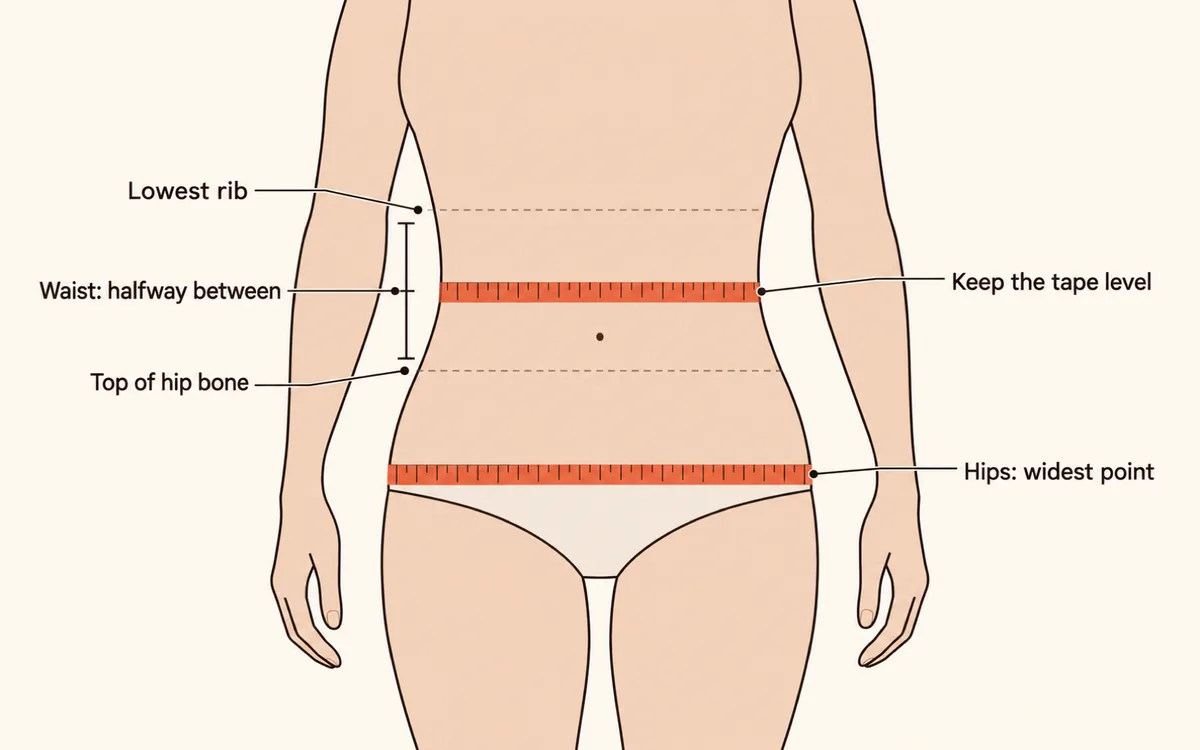
Then your hips
Same tape, same rules, around the widest part of the buttocks with your feet together. Look at yourself side on to find the widest point; it is usually lower than people expect. Divide the waist by this number and you have the ratio the calculator gives you.
When to measure
First thing in the morning, before you eat or drink and after the bathroom. A big meal, a salty day or a bloated afternoon can add a centimetre or two that is not fat, which is the same reason your weight jumps around overnight. Every two to four weeks is often enough to see a trend. Weekly readings mostly measure noise.
No tape measure?
Use anything that does not stretch: a piece of string, a phone charger cable, a shoelace or a strip of paper. Wrap it round the same spot, pinch where it meets, lay it flat against a ruler or a printed A4 sheet (29.7 cm on the long side, 11 inches on US letter). Wool and elastic stretch, so skip them. A cloth sewing tape from a pharmacy costs very little and is worth buying if you plan to track.
The mistakes that skew it
| Mistake | What it does |
|---|---|
| Measuring at the trouser line | Reads the hips, not the waist. Trouser sizes are not waist sizes either; a pair labelled 34 often measures an inch or two more. |
| Tape sloping down at the back | Adds length every time, often 2 cm or more |
| Holding the breath or sucking in | Takes several centimetres off, and you cannot repeat it the same way next time |
| Measuring over a shirt | Adds the fabric and hides where the tape actually sits |
| Different spot each time | The waist changes width fast from rib to hip, so a small shift up or down looks like progress or a setback that never happened |
What the waist alone tells you
The ratio needs two numbers. The waist on its own is still useful, and these are the cut offs most health services use:
| Men | Women | |
|---|---|---|
| Increased risk | Over 94 cm (37 in) | Over 80 cm (31.5 in) |
| Substantially increased risk | Over 102 cm (40 in) | Over 88 cm (35 in) |
| South Asian and East Asian cut off | Over 90 cm (35.5 in) | Over 80 cm (31.5 in) |
The simplest rule of all, used by the NHS in the UK: keep your waist to less than half your height. A person 170 cm tall wants a waist under 85 cm. It needs no chart and works for every sex and build.
What the bands mean
The ratio is waist divided by hips. Dividing by the hips is what takes frame size out of it, so the number compares between two people in a way a waist measurement on its own cannot.
| Band | Men | Women |
|---|---|---|
| Low risk | Under 0.90 | Under 0.85 |
| Moderate risk | 0.90 to 0.99 | 0.85 to 0.89 |
| High risk | 1.00 and above | 0.90 and above |
One number, not the whole picture. This is a screen, and a crude one. It says nothing about blood pressure, blood sugar, fitness or what you eat, and it should never be the reason you decide something about your health on your own. A doctor with your bloods knows more than a tape measure does.
Why the middle is the part that matters
Fat on the hips and thighs sits under the skin. Fat around the middle also packs in around the organs, and that visceral fat behaves differently: it is metabolically active, it drives inflammation, and it tracks with heart disease and type 2 diabetes far more closely than total body weight does.
That is the whole reason a ratio beats a scale here. Someone can be an average weight and carry a shape that raises risk, and the scale will never mention it.
Moving it
There is no exercise that takes fat off one region. Sit ups build the muscle under the fat and leave the fat where it is. What actually shrinks a waist is an overall calorie deficit, and the middle tends to respond earlier than most places, which is a rare piece of good news in this field.
Start with the deficit. The calorie calculator gives you the daily target, and the body fat calculator uses the same tape to tell you whether what you are losing is fat.
The waist responds to a calorie deficit even without training; losing weight without exercise explains how.
Sources
- Waist circumference and waist hip ratio: report of a WHO expert consultation, World Health Organization, 2011
- The IDF consensus worldwide definition of the metabolic syndrome, International Diabetes Federation, 2006
- Overweight and obesity management (NG246), National Institute for Health and Care Excellence, 2025
How this was made
Written by Abdullah Javaid, founder of Calfit, drafted with AI assistance and edited by hand. The ratio is your waist divided by your hips, and the risk bands are the WHO cut offs for men and women. The waist thresholds are the WHO and International Diabetes Federation figures, and the half your height rule comes from NICE guidance used by the NHS.
Quick questions
What is a good waist to hip ratio?
Why measure the ratio rather than the waist alone?
Is waist to hip ratio better than BMI?
How do I measure my waist and hips?
How do I measure my waist without a tape measure?
What is a healthy waist size?
Where exactly is your waist?
Can you change your waist to hip ratio?
Keep reading