
The short answer
Most people lose weight steadily eating 300-500 calories below their maintenance level, the amount their body burns in a normal day. For many women that target lands somewhere around 1,400-1,800 kcal and for many men around 1,800-2,300 kcal, but your own number depends on your age, height, weight and how active you are. Guessing from someone else's plan is exactly how diets end up either miserable or ineffective. If you'd rather credit a specific walk than a flat activity multiplier, the steps to calories calculator converts a step count directly.
Or skip to the number. The calorie calculator runs this whole calculation and shows your BMR and maintenance alongside the target.
Skip the arithmetic. The macro calculator runs the same Mifflin St Jeor equation described below and hands you the number, plus the protein, carbs and fat to go with it.
Finding your maintenance calories
Maintenance has two parts:
- Your BMR (basal metabolic rate), what your body burns just existing. Estimation formulas like Mifflin-St Jeor use your sex, age, height and weight.
- An activity multiplier, from about 1.2 if you sit most of the day to 1.7+ if your job or training keeps you moving.
BMR × activity ≈ maintenance. Subtract 300-500 and you have a sensible weight-loss target. A 500 kcal daily deficit works out to roughly half a kilo (about one pound) per week, which is the pace that tends to survive real life, birthdays, holidays, Tuesdays.
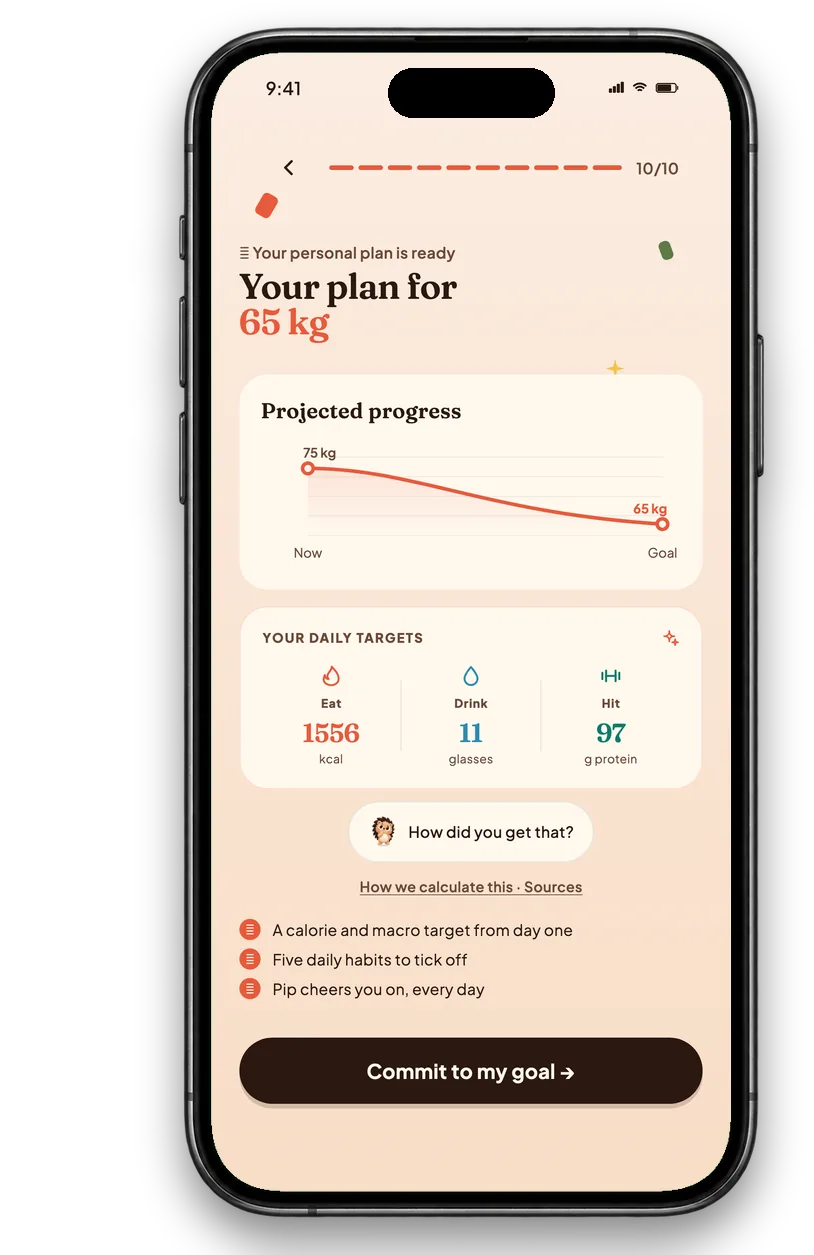
Skip the spreadsheet: Calfit runs this calculation in onboarding (age, height, weight, activity, goal) and hands you a personal daily target before your first meal. No formula required.
Why your number must change over time
Here's the trap almost every calorie calculator sets: it gives you one number, forever. But a lighter body burns fewer calories. Lose 5 kg and the target that was a 500-calorie deficit might now be a 250-calorie one. Progress slows, motivation follows it down, and it feels like the diet “stopped working.” It didn't. The math moved and the number didn't.
This is why Calfit's target is adaptive: it watches your weigh-in trend and quietly recalculates your daily calories as your weight changes. You keep an honest deficit without redoing any math, the calorie calculator you never outgrow. Eating low carb instead, the keto calculator runs the same maintenance math split into net carbs, protein and fat.
Signs your target is wrong
- Too aggressive: constant hunger, poor sleep, dreading meals, weight dropping much faster than ~1% of body weight per week. Sustainable beats fast.
- Too gentle: four weeks of honest logging and the trend line hasn't moved. Nudge down by 100-200 kcal or add a daily walk.
- Just right: steady downward trend, energy intact, and you can imagine eating this way in six months.
Make the number easy to hit
Knowing your target is the easy half. The hard half is knowing how much of it you've used by 3pm. That's the job of a fast food log: snap a photo, get calories and macros in about five seconds, and always know your calories left for the day, which is what actually changes the dinner decision. Pair it with a sane deficit and a trend chart that ignores daily noise, and the whole thing starts to feel less like dieting and more like keeping score of a game you're winning.
To see what that target means in weeks, read how long it takes to lose 10 kg.
Sources
- A new predictive equation for resting energy expenditure in healthy individuals (Mifflin St Jeor), American Journal of Clinical Nutrition, 1990
- Human energy requirements: report of a joint FAO, WHO and UNU expert consultation, Food and Agriculture Organization, 2004
- Quantification of the effect of energy imbalance on bodyweight, The Lancet, 2011
- Body Weight Planner, National Institute of Diabetes and Digestive and Kidney Diseases, 2019
- Managing your weight, NHS, 2021
How this was made
Written by Abdullah Javaid, founder of Calfit, drafted with AI assistance and edited by hand. Maintenance is estimated with the Mifflin St Jeor equation multiplied by an activity factor from about 1.2 to 1.7, and the target subtracts 300 to 500 kcal from it. The screens are captures from the current Calfit app.