
The plain-English definition
Your maintenance calories are what your body spends in a typical day: heartbeat, brain, digestion, fidgeting, walking to the kettle, and any workouts. Nutrition people call it TDEE (total daily energy expenditure). Eat exactly this number and your weight stays put. Eat under it and you lose; over it and you gain. Every diet ever invented is a strategy for staying under this one number.
Find yours in one step. The macro calculator estimates your maintenance, then shows what a deficit or a surplus does to it.
What's inside the number
- BMR (60-70%): what you'd burn in a coma, driven by your size, age and sex. This is the big, boring, non-negotiable slice.
- Daily movement / NEAT (15-30%): steps, chores, fidgeting, standing. The most variable slice, and the reason two same-sized people can differ by 400 kcal a day.
- Digestion / TEF (~10%): processing food costs calories. Protein costs the most, which is one of its quiet advantages.
- Exercise (0-15% for most people): smaller than the gym mirror suggests. A hard 45-minute session is ~300-450 kcal, real, but not license for a large pizza.
How to calculate yours
Formulas like Mifflin-St Jeor estimate BMR from your sex, age, height and weight; multiply by an activity factor (1.2 sedentary → 1.7 very active) and you have a TDEE estimate. Two honest warnings: people overrate their activity level (a desk job plus three gym visits is "lightly active," not "very active"), and any formula is a population average with a ±10% error bar for individuals. Treat the output as a starting guess, then let 3-4 weeks of scale trend correct it.
The measured method beats the formula: track intake honestly for two weeks alongside daily weigh-ins. Flat trend = you found maintenance. Falling ~0.5 kg/week = you're ~500 under. Your body just told you its number.
The part everyone misses: the number moves
Maintenance isn't a constant, it follows your body size down. Lose 6 kg and your TDEE drops by roughly 120-150 kcal/day. Diets "stop working" on schedule because the target that was a 500-kcal deficit in January is a 300-kcal deficit by April. Nothing broke; the anchor moved. Recalculate every few kilos, or use a target that recalculates itself.
Maintenance calories, TDEE and BMR, which are three different numbers
This is the most common confusion on the topic, so here it is in one place.
| Term | What it counts | Rough size for a 75 kg adult |
|---|---|---|
| BMR, basal metabolic rate | Keeping you alive at complete rest. Heart, lungs, brain, organs. Nothing else. | about 1,600 kcal |
| TDEE, total daily energy expenditure | BMR plus digestion, plus every movement, planned or not. | about 2,400 kcal |
| Maintenance calories | What you eat to hold your weight steady. In practice the same number as TDEE. | about 2,400 kcal |
Maintenance calories and TDEE are the same thing named from two directions. TDEE describes what you spend, maintenance describes what you eat to match it. If you are holding steady, they are equal by definition. Nothing is lost by treating them as interchangeable in everyday use.
BMR is a different number and a much smaller one, typically 60 to 70% of TDEE. Eating at your BMR is not maintaining, it is a substantial deficit, and this mix up is a genuinely common reason people end up eating far too little without meaning to.
Does maintenance include exercise?
Yes, and that is exactly what separates it from BMR. TDEE, and therefore maintenance, is built from four parts:
- BMR, roughly 60 to 70% of the total
- The thermic effect of food, about 10%, the energy spent digesting what you ate
- Planned exercise, usually 5 to 10% for most people, which is far less than the gym would like you to believe
- Everything else you move, called NEAT: walking, fidgeting, standing, carrying shopping. This is 15 to 30% and it is the most variable part by a wide margin
The practical consequence is that the gym is not the big lever. The difference between a sedentary desk day and an active one is often 400 to 600 kcal of NEAT, which dwarfs a 300 kcal gym session. It is also why maintenance quietly falls when you start dieting: people move less without noticing it.
If you use a calculator with activity multipliers, and ours is at the calorie calculator, the multiplier is trying to capture exercise and NEAT together. Most people overestimate it by one full step, which is the commonest reason a calculated maintenance comes out 200 to 300 kcal too high.
How to find your real maintenance, rather than a calculated one
Every formula is a population average applied to one person, and it can be out by 200 to 300 kcal in either direction. The only number that is actually yours comes from measuring.
- Eat and log normally for 10 to 14 days. Do not try to be good. You are measuring your habit, not auditing it.
- Weigh yourself daily, same conditions, and take the weekly average rather than any single day.
- Compare week one's average with week two's. Steady means you found maintenance, and your average daily intake over those two weeks is the number.
- If weight moved, adjust. Roughly 0.5 kg of change a week corresponds to about 500 kcal a day, so a 0.25 kg rise means eating about 250 kcal less.
Two weeks is the minimum because water shifts easily hide a real trend inside a single week. A calculator gives you a starting guess in ten seconds and this gives you the truth in a fortnight, so do both, in that order.
Maintenance days, maintenance phases, and reverse dieting
A maintenance day is a single day eating at maintenance in the middle of a deficit. It is mostly psychological and there is nothing wrong with that.
A maintenance phase is one to three weeks at maintenance, taken deliberately after 8 to 12 weeks of dieting. This is the one that matters. It lets the hormonal and behavioural effects of restriction settle, and in practice it is often the difference between finishing a plan and quitting in month three.
Reverse dieting is raising intake gradually, perhaps 50 to 100 kcal a week, back up to maintenance after a diet ends. The strong claims made for it, that it substantially raises your metabolism, are not well supported. The modest and defensible version is that it gives you a controlled way to find your new maintenance without the rapid regain that follows going straight back to eating what you ate before, which is a real and common problem.
Worth disagreeing with: the idea that maintenance is a fixed personal constant. It is a moving average of a number that changes with your weight, your activity, your sleep and even the season. Lose 10 kg and your maintenance falls by roughly 200 to 300 kcal, partly because there is less of you to run and partly because you move less than you did. A number you calculated six months ago is not your number today.
Maintenance calories in Calfit
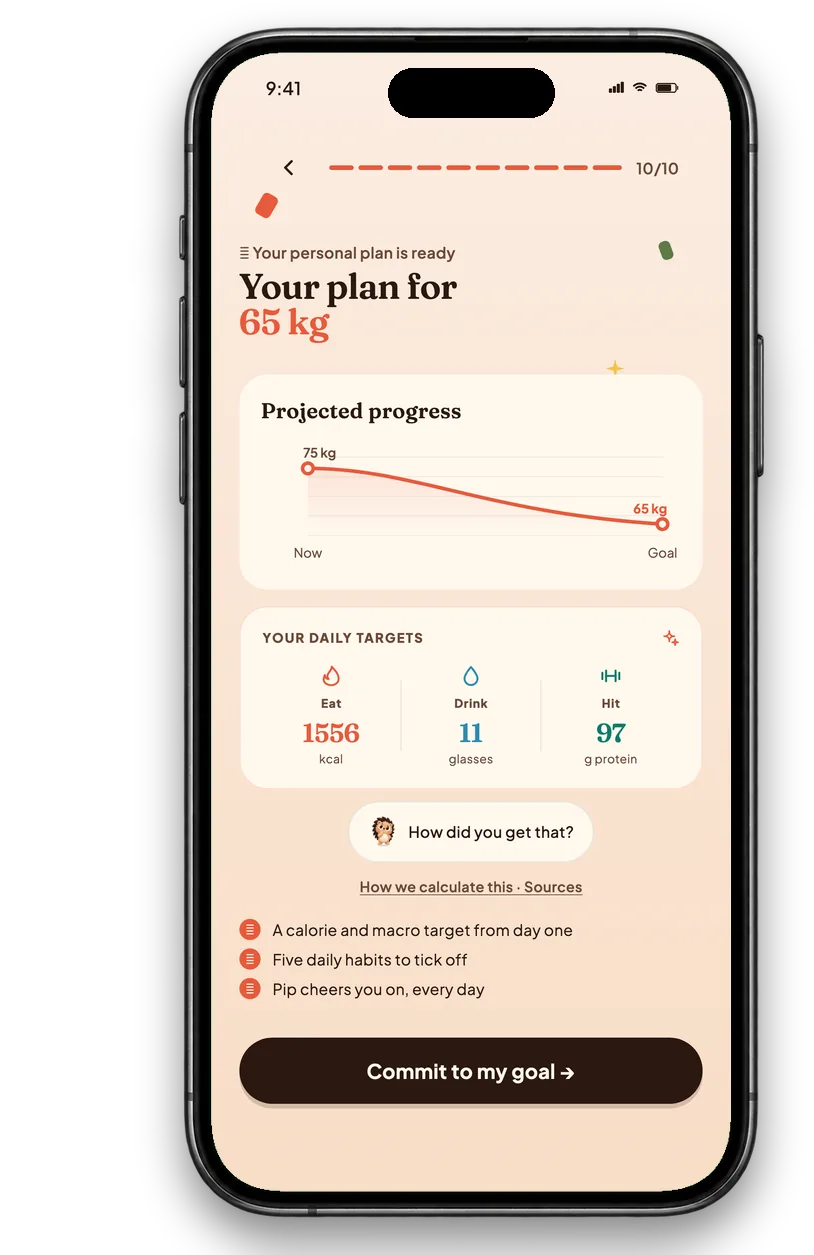
Calfit runs the estimate during onboarding (age, height, weight, activity, goal) and sets your daily target from it. Then it does the thing formulas can't: it watches your weigh-in trend and quietly re-anchors the target as your real-world numbers come in. Your maintenance stays current without you ever re-opening a calculator, and Pip never once says "TDEE."
Sources
- A new predictive equation for resting energy expenditure in healthy individuals (Mifflin St Jeor), American Journal of Clinical Nutrition, 1990
- Comparison of predictive equations for resting metabolic rate in healthy nonobese and obese adults, Journal of the American Dietetic Association, 2005
- Human energy requirements: report of a joint FAO, WHO and UNU expert consultation, Food and Agriculture Organization, 2004
- Non exercise activity thermogenesis (NEAT), Best Practice and Research Clinical Endocrinology and Metabolism, 2002
- Diet induced thermogenesis, Nutrition and Metabolism, 2004
- Quantification of the effect of energy imbalance on bodyweight, The Lancet, 2011
How this was made
Written by Abdullah Javaid, founder of Calfit, drafted with AI assistance and edited by hand. BMR estimates use the Mifflin St Jeor equation, the component percentages for BMR, thermic effect, exercise and NEAT are the standard ranges used in energy balance work, and the 7,700 kcal per kilogram figure behind the adjustment arithmetic is a planning approximation rather than a physiological constant. The screens are captures from the current Calfit app.