First, the uncomfortable truth about "eating less but not losing weight"
If you're genuinely in a calorie deficit, you lose fat. That part of the physics has no known exceptions. So when the scale won't move for weeks, one of two things is true: the deficit isn't as real as you think, or the scale is hiding the loss. Both happen constantly, both are fixable, and neither means you're broken.
Suspect 1: hidden calories (the big one)
Studies where researchers checked people's actual intake against their food diaries found underreporting of 30-47%, not from lying, from invisibles. The usual leaks:
- Cooking oil. A generous glug is 200+ kcal that never gets logged.
- Drinks. Lattes, juice, "a splash" of anything. 150 kcal, three times a day.
- Bites and finishes. The toddler's leftover nuggets, the sauce-pan taste test, the "just one" biscuit at work.
- Weekend amnesia. A 500-kcal weekday deficit is fully erased by two loose weekend days. The weekly average is what your body experiences.
Fix: log everything for two honest weeks, photos make this fast enough to actually do. You're not looking for guilt, you're looking for the leak.
Suspect 2: water is sitting on top of your fat loss
Fat loss and scale weight are different curves. New workouts, salty dinners, higher-carb days and hormonal cycles can hold 1-2 kg of extra water for days or weeks, comfortably hiding a real 0.5 kg/week fat loss underneath. This is the single most common "plateau" and it resolves on its own. The tell: your weight trend line over 3-4 weeks, not any individual morning.
Suspect 3: your maintenance dropped and your target didn't
Every kilo you lose lowers the calories your body burns. Lose 5-6 kg and the target that used to be a 500-kcal deficit might now be a 200-kcal one, progress slows to a crawl and it feels like failure. It's just stale math. Recalculate your maintenance calories, or use a tracker whose target updates itself as the scale moves.
Suspect 4: portion drift
Week one, you measured the rice. Week nine, you eyeball it, and the eyeball has quietly grown 20%. Nobody's immune. A two-week return to honest measuring (or photo scans, which don't drift) usually finds 150-300 kcal a day hiding in "the same meals I always eat."
Suspect 5: the deficit is too aggressive, so adherence collapsed
Huge deficits look great on paper and fail in kitchens. Eat 1,100 kcal from Monday to Thursday and Friday-to-Sunday tends to eat back the difference, the week averages out to maintenance and the scale stays put. A moderate 300-500 kcal deficit you can hold every day beats a heroic one you can only hold until Thursday.
The 4-week test: log honestly for four weeks, weigh daily, judge only the trend line. Trend down? You were never stuck. Trend truly flat? Now you have real data, drop the target ~150 kcal or add a daily walk, and re-test.
How Calfit makes this diagnosis automatic
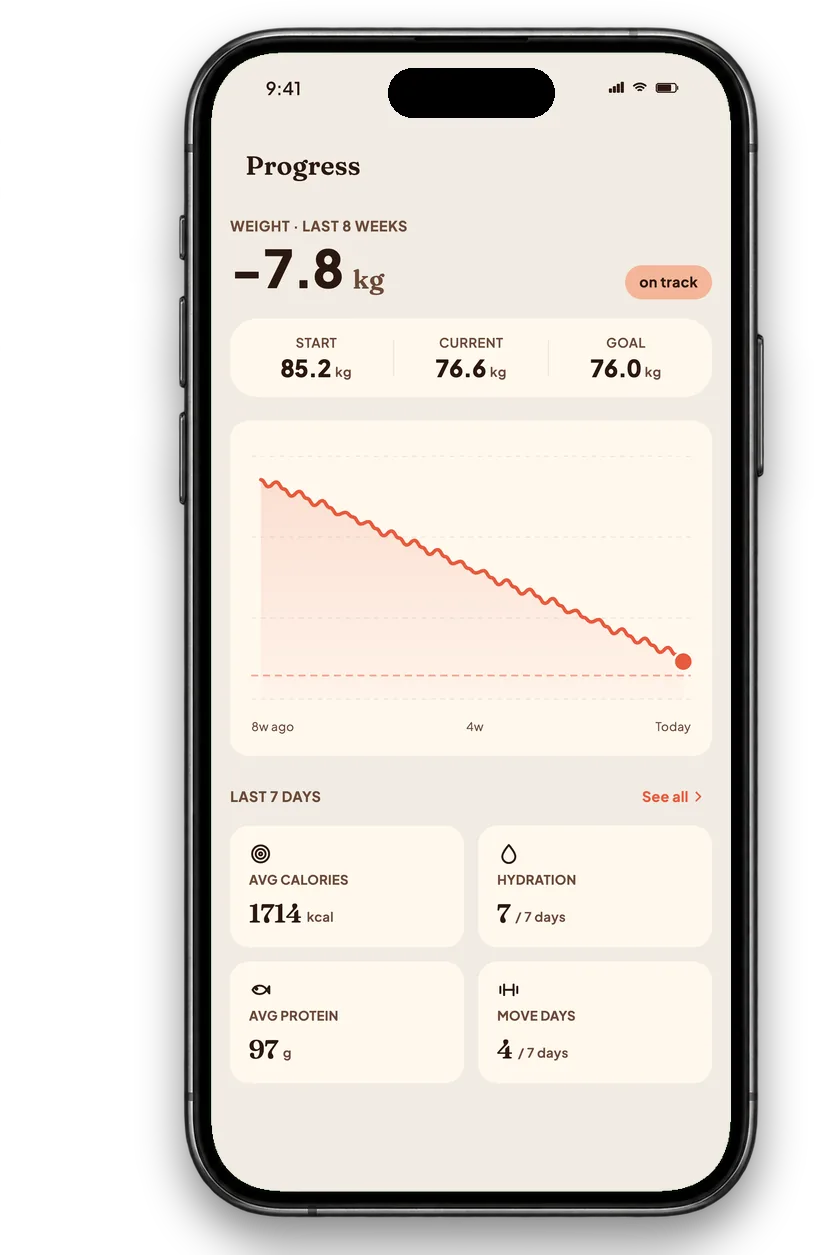
This whole checklist is built into the app: photo logging catches the oil and the bites (five seconds per meal, so weekends get logged too), the weight chart draws the trend line through the water noise, and the calorie target recalculates itself as you lose, so suspect #3 never happens. Pip just keeps the streak. The streak is what makes the data honest. See the full list in what a calorie counter app should do, and if the scale feels stuck the waist to hip ratio calculator tracks shape change the scale alone can't show.
Sources
- Discrepancy between self reported and actual caloric intake and exercise in obese subjects, New England Journal of Medicine, 1992
- Validity of dietary assessment methods when compared to the method of doubly labeled water: a systematic review in adults, Frontiers in Endocrinology, 2019
- Quantification of the effect of energy imbalance on bodyweight, The Lancet, 2011
- Glycogen storage: illusions of easy weight loss, excessive weight regain, and distortions in estimates of body composition, American Journal of Clinical Nutrition, 1992
- Body Weight Planner, National Institute of Diabetes and Digestive and Kidney Diseases, 2019
How this was made
Written by Abdullah Javaid, founder of Calfit, drafted with AI assistance and edited by hand. The under reporting range comes from studies that compared food diaries with measured intake, and the deficit arithmetic uses about 7,700 kcal per kilogram of body fat as a planning figure. The screens are captures from the current Calfit app.